

Music already means something to you before you ever play a note. Maybe you love singing acoustic songs or tapping beats on a table. Learning an instrument turns your interest into something you get to shape with your own hands.
Anyone who hasn’t played an instrument before may wonder how difficult it is to strum chords on a guitar or decipher sheet music. If you have a love for music and want to explore different rhythms and melodies, one of these beginner-friendly musical instruments might be for you.
Piano or Keyboard
Press a key, and the note sounds right away. The direct response makes piano or keyboard appealing to people who want to focus on melody. A piano uses hammers to strike strings inside its body. It delivers everything from soft reflective notes to big dramatic chords.
Digital keyboards produce sounds electronically, paired with the familiar arrangement of black and white keys. From electric piano tones to strings, organs, and playful synthesizer effects, they invite individuals to experiment with sounds.
Reading Sheet Music
Piano sheet music uses five horizontal lines called a staff, and each note appears as a small oval placed on a line or in a space. The treble clef usually guides the right hand, while the bass clef guides the left hand. Beginners learn to connect each note’s position with a key by memorizing a few reference notes, then counting upward or downward through the staff. The keyboard’s repeating pattern of black and white keys reinforces those relationships because each written note matches one specific key.
In early lessons, you’ll learn one hand at a time with short melodies and simple rhythms. A beginner reads from left to right, identifies the note, finds its matching key, and watches for symbols that show how long to hold it.
Acoustic Guitar
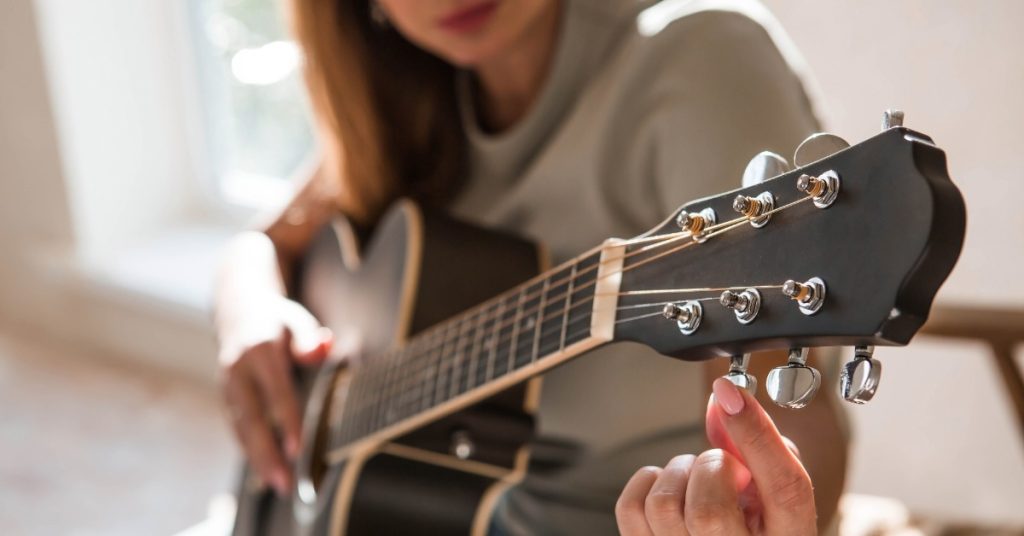
Acoustic guitars range from soft and mellow to bright or punchy, depending on the player’s touch. A gentle strum supports the singer’s voice, while a strong attack brings out a lively rhythm. Players who enjoy singer-songwriter music or unplugged versions of favorite songs will connect with this instrument quickly.
As part of the string family, its familiar voice spans folk, country, rock, and pop. The first few chord changes challenge your fingers, yet the payoff arrives quickly once familiar songs begin to take shape.
Understanding the Chords
Guitarists read standard sheet music from left to right across a five-line staff. Each note’s position shows its pitch, while its shape indicates how long to play it. The guitar’s tuning gives each open string a specific note, and players use fret numbers to find the same pitches in different positions. Beginners often start with one-note melodies before combining notes with chords.
Many new players begin with chord diagrams or tablature instead. Chord diagrams show finger placement across the strings, while tablature uses six lines to represent the guitar strings and numbers to identify the frets. A number tells you where to place a finger, and numbers stacked vertically signal notes played together. Anyone choosing an acoustic guitar can use these visual tools to play familiar chord progressions before standard notation becomes part of regular practice.
Drums
If you’re constantly listening to the beat beneath the lyrics, drums might be a natural fit. As percussion instruments, drums focus on rhythm rather than melody, so beginners spend less time learning pitches and more time exploring timing and movement. Some people start with a single drum, like a snare or hand drum, while others choose a full drum set with multiple pieces. Coordinating both hands and feet takes practice, but simple beats often sound satisfying before every part of the kit feels completely comfortable.
Each drum adds a different texture, from the deep thump of the bass drum to the sharp snap of the snare. A single drum helps beginners focus on timing and hand technique. On the other hand, a drum set introduces cymbals, toms, pedals, and complex coordination. Together, those sounds shape the groove behind rock, pop, funk, and more.
Learning Drum Patterns
Drum patterns show when to strike each part of the kit across a steady count. A beginner might see a bass drum mark on beats one and three, a snare mark on beats two and four, and repeated hi-hat marks between them. Each symbol points to a specific drum or cymbal, so players build the groove by combining separate parts instead of following a line of pitched notes.
Early lessons start by mastering the use of one limb at a time to avoid confusion. You might play a steady hi-hat pattern with your right hand, add the bass drum with your foot, and bring in the snare with your left hand. As the pattern makes more sense and your skills sharpen, you’ll be able to maintain a steady beat.
Flute
Light, airy, and expressive, the flute brings a graceful voice to many musical settings. Although modern concert flutes often use metal, musicians classify them as woodwind instruments because players blow air across an opening to produce sound. That design gives beginners a direct connection between breath and tone.
Producing a steady first note takes patience and control. Once players develop a consistent embouchure, the flute responds with bright melodies and smooth phrases. Orchestras and concert bands feature its clear sound, while film composers often use it to suggest movement, wonder, or calm. Beginners who enjoy graceful melodies and expressive playing may find the flute especially rewarding because small changes in breath can shape each phrase.
Understanding the Notes
Learning flute notes involves more than pressing one key and hearing a pitch. Each note requires a specific combination of keys, so beginners gradually connect the symbols on the page with their fingers and breath. A player reads a note on the staff, chooses the matching fingering, and directs air across the opening to produce the pitch.
Flute sheet music follows a system similar to piano music. However, this woodwind instrument will only have one note played at a time. Some notes use only a few fingers, while others require several keys at once. With steady practice, those finger patterns become second nature.
Trumpet
Whether you play the trumpet solo or join a full ensemble, this brass instrument has a bright, commanding tone. It produces sound when players buzz their lips into the mouthpiece and guide air through the tubing. Three valves change the pitch, giving beginners a clear physical system to learn as they build breath control and develop a steady tone.
Its bold voice brings energy to jazz solos and marching band performances. For classical music, the trumpet’s dramatic sound produces memorable melodies. If you enjoy music that has plenty of movement and volume, the trumpet is an exciting instrument.
Mastering the Technique
Trumpet players usually encounter standard notation early because the instrument follows one melodic line at a time. Each note on the staff corresponds to a specific pitch. The valves help produce the written notes through different finger combinations. Players also adjust their lip position and airflow to reach the correct pitch.
As those note-and-valve relationships become familiar, the staff starts to feel more like a map than a puzzle. A short melody then gives players clear guidance about which notes to play and when to play them, making the transition from reading music to performing it feel more natural.
Which Instrument Do You Want To Learn?
Every musical instrument that a beginner tries will come with a learning curve. However, the one that you pick should leave you curious enough to pick it up again after a difficult practice session. Soon enough, pressing the keys or strumming a chord will feel second nature.